12.8.2008 | By SBC Staff |
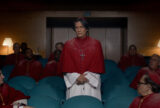
Elizabeth Peña stares at her grown son across the Christmas table. He hasn’t told her about Iraq. She already knows. That single look carries forty years of Puerto Rican motherhood, and seventeen years later, we still haven’t seen another mainstream holiday film capture anything close to it.
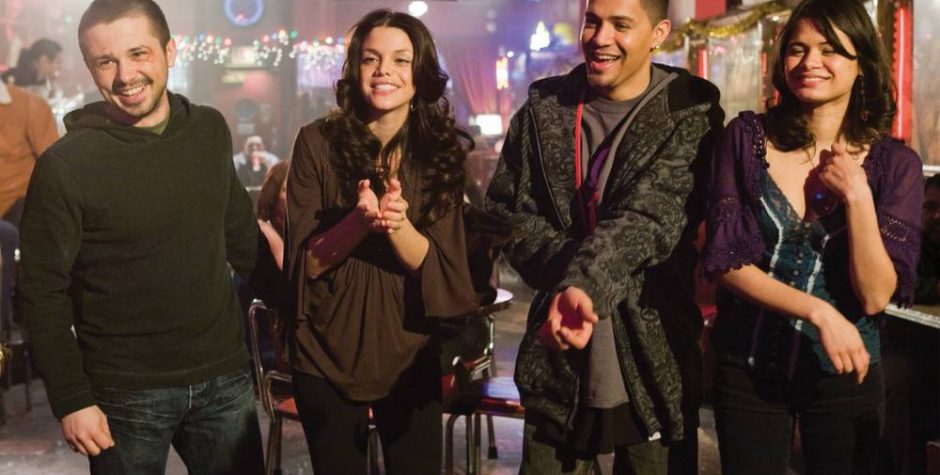
The Rodriguez siblings return to Chicago’s Humboldt Park for what might be their last Nochebuena together. Their mother wants a divorce. Their father is hiding something worse. Directed by Alfredo De Villa and driven by Puerto Rican actor Freddy Rodriguez, this 2008 theatrical release set a standard for Latino holiday films that Hollywood has refused to match since. The performances are why.
De Villa assembled an ensemble that feels like an actual family reunion. Veterans anchor the chaos while younger actors push against them, and the friction generates real heat.
The late Elizabeth Peña, of Cuban descent, transforms from demanding matriarch to vulnerable wife across a single dinner scene. As Anna, she conveys decades of swallowed disappointment in one glance at her husband. What makes her memorable is the specificity: she wounds with a raised eyebrow, heals with a plate of food, holds everyone together through sheer gravitational force. Watching her now, years after her passing, adds a weight that makes every scene hit differently.
Colombian-American actor John Leguizamo is the exposed nerve. He plays Mauricio, the attorney desperate to save his parents’ marriage. He transforms from polished professional to pleading son by the third act, conveying the terror of watching your foundation crack. What makes him memorable is how he carries hope like a wound.
The film’s most unexpected arc belongs to Mexican-American actor Jay Hernandez as Ozzy, a man whose brother was murdered. When the killer gets released from prison, Ozzy must decide what kind of man he wants to be. Hernandez conveys that internal war in every scene, from his eyes at the park when he first spots Alexis, to his gentleness with Roxanna, a woman he adores but feels unworthy of. The moment he throws that gun into the river, Hernandez makes us believe a man can choose a different path. He showed early signs of the leading man presence that would later carry the Magnum P.I. reboot.
These performances land because De Villa gives them room to breathe inside chaos. The film’s signature choice is sonic: conversations overlap, insults fly without apology, people scream to be heard over the coquito and the cousins. This serves the story by making us feel trapped inside the family, which is exactly where we should be. There is no escape, and there shouldn’t be. The volume is the love.
Listen closer to that noise, and you hear something specific. The code-switching is effortless. The siblings slip between English and Spanish mid-sentence without announcement or translation. When Leguizamo’s Mauricio tells his wife “They’re not fighting. They’re conversating,” he is translating not just words but an entire cultural reality.
We need films that present Latinos outside of tired stereotypes. Nothing Like the Holidays delivers a family that is undeniably American and unapologetically Puerto Rican, dealing with universal issues: infidelity, illness, PTSD, the fear of disappointing our parents.
The cultural truth it reveals is one we recognize from our own households: the siblings are Americanized, rolling their eyes at guilt trips, switching languages without thinking. But the parents anchor them to the island and the past. That duality, belonging fully to two worlds and completely to neither, speaks directly to millions of US Latinos who rarely see that tension reflected on screen. We see ourselves in the Rodriguez family. That matters. This is not an outsider’s interpretation of Puerto Rican life. It is Puerto Rican life, set in Chicago, told without translation.
Which raises the question: could this film get made today?
In 2008, Nothing Like the Holidays received a wide theatrical release in over 1,600 theaters. According to the 2025 UCLA Hollywood Diversity Report, only 1% of Latino performers held leading roles in top theatrical films last year. Eva Longoria said this week that Latino representation is headed in the “wrong direction.” In 2025, this same film would likely be a streaming original buried under an algorithm. Or it would not get made at all.
The third act leans into melodrama, and some resolutions wrap too neatly. But the larger point stands: Nothing Like the Holidays proved that studios could put a Latino ensemble film in theaters nationwide. They did it once. They could do it again. We are still waiting.