Latino columns, essays on movies, TV, and culture

Jack Rico

By

2010/03/06 at 12:00am

Oscar 2010: My Winning Predictions

03.6.2010 | By |

The 2010 Oscars are here and fans have their thoughts of who should be the winners on Oscar night. I’ll be personally looking at the Foreign Films category because that is where I think the best films of 2009 are! Two Latin American films are nominated. My peeps are putting their share! Read More


Jack Rico

By

2008/12/08 at 12:00am

‘Nothing Like The Holidays’ Deserves a Rewatch and a Sequel

12.8.2008 | By |

*Updated December 2025

In the dinner scene of Alfredo De Villa’s 2008 film Nothing Like the Holidays, Anna (the late Elizabeth Peña) stares at her husband across the table and drops a grenade: she is leaving him. The room goes silent. Thirty-six years of marriage, three grown children, the bodega, and the house in Humboldt Park, all over on Nochebuena.


To the typical moviegoer, this dysfunctional scene is a cliché usually reserved for white American holiday movies. Think The Family Stone. But for the American Latino viewer, this was a cinematic landmark. It was the first time we watched our own holidays, in English, reflected back in a wide release, playing next door to Keanu Reeves’ The Day the Earth Stood Still.

Historically, Latino holiday stories were relegated to Univision or straight-to-DVD releases. But Nothing Like the Holidays was the first mainstream, wide-release, English-language film to center entirely on an American Latino family’s Christmas. It was the first time a studio put financial investment behind the day’s biggest Latino names, John Leguizamo, Freddy Rodriguez, and Jay Hernández, for a wide holiday release. It seemed they were finally treating our stories not as a curiosity for Hispanic Heritage Month, but as American art.

Rewatching it 17 years later, three things hit me about this family and the price they pay for “making it” in America.

The Cost of the American Dream

The first is how the American Dream is represented through the three Rodriguez siblings. Jesse, Roxanna, and Mauricio all left Chicago’s Humboldt Park to aspire to a “better life” than their parents. Like many American Latinos, we are taught that the way out of the neighborhood requires a form of assimilation.

Jesse (Freddy Rodriguez) chose the military. But as soon as he appears on screen, it’s clear he never really got out. He returns from Iraq carrying the death of his friend and the unbearable guilt of his own survival, a sacrifice made for a country that barely sees him as American.

Jay Hernández, Freddie Rodriguez, Luis Gúzman in Nothing Like The Holidays

Jay Hernández, Freddy Rodriguez, Luis Gúzman in ‘Nothing Like The Holidays’

Roxanna (Vanessa Ferlito) chose Hollywood. She chased the dream of being seen, only to be reduced to Señor Taco commercials on local TV. She left the neighborhood to be visible, yet she is more invisible than ever.

Vanessa Ferlito in Nothing Like The Holidays

Vanessa Ferlito in ‘Nothing Like The Holidays’

Then there is Mauricio (John Leguizamo). His character is the most complex because his American Dream is racial. He chooses full-on assimilation through the status markers of a law degree, a white Jewish wife, and a white-passing life. But his choice for a “better life” means trading in his old identity for a new one where nobody looks like him.

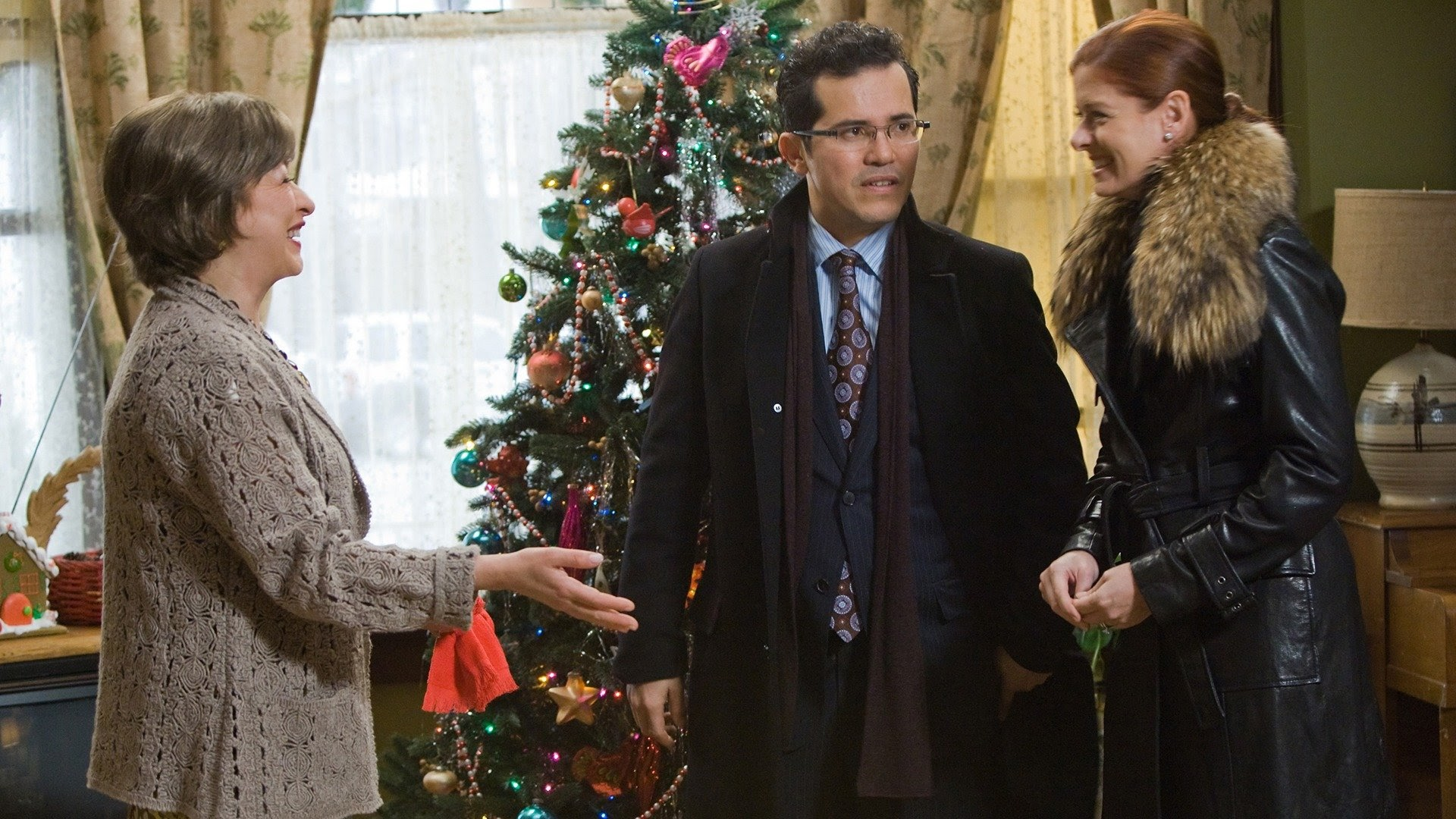
Elizabeth Peña, John Leguizamo, Debra Messing in Nothing Like The Holidays

Elizabeth Peña, John Leguizamo, Debra Messing, in ‘Nothing Like The Holidays’

The movie ultimately does not judge the Rodriguez siblings for leaving the neighborhood, it just looks at the silent cost of surrendering your Latinidad for inclusion. It exposes the brutal irony at the heart of many immigrant families, that the American Dream often requires abandoning the very people who made it possible.

The Credential of Assimilation

The second most interesting dynamic in the movie that resonated with me was Mauricio’s wife, Sarah, played by Debra Messing (Will & Grace). Whether he admits it or not, Sarah is his credential, proof to the neighborhood and his family that he has succeeded.

For white viewers, Sarah is a supportive wife and high-powered hedge fund manager doing her best inside a culture not her own. But to Anna, Sarah’s “native” confidence and natural sense of “ownership” rub her the wrong way. The friction peaks when Johnny (Luis Guzmán) jokes about their future “sorta-rican” babies. Sarah misses the subtext that with every marriage outside the family, the culture fades a little more. Mauricio knows this. He has accepted the transaction as the cost of doing business in America.

Hollywood’s “Latino American” vs. “American Latino” Problem

The third thing that struck me so clearly was the rarity of the American Latino story on screen.

When you see any theatrical release, you most likely see a symbol of escapism, but it is also a high-stakes financial bet. It takes millions of dollars and years of sweat to sit down and watch. When a studio makes that kind of investment behind a movie, it sends a loud and clear message to the subject: This story matters. You matter. It tells you that your existence is worthy of the big screen. And when a studio believes a story is special, it makes you feel special, because that story is yours.

In Hollywood though, American Latino stories are rare. What there are plenty of are Spanish-language “Latino American” border stories centering the immigrant arrival-survival struggle. Those projects naturally hire international Latino and Hispanic actors. But the stories of Latinos just living here, the life that happens after the border, are rarely told. And because those stories are not being written, the Latino actors born here in the U.S. are not getting the work.

Freddie Rodriguez, Vanessa Ferlito, Jay Hernandez, Melanie Ortiz in Nothing Like The Holidays

Freddy Rodriguez, Vanessa, Ferlito, Jay Hernández, Melonie Díaz in ‘Nothing Like The Holidays’

This is why Nothing Like the Holidays is a unicorn, because it captured that post-border reality and brought us inside the Hollywood holiday movie canon.

But to get this American Latino story greenlit, the studio chose a mostly Pan-Latino ensemble of mainstream known U.S. Latino actors to play a Puerto Rican family. The cast featured Colombian-American John Leguizamo, Mexican-American Jay Hernández, and Cuban-American Elizabeth Peña, alongside non-Latinos like Vanessa Ferlito and Alfred Molina. Yet, we believed it. Why? Because English is the great equalizer. As long as you sound American, you pass the audience’s litmus test.

The truth is, had the studio insisted on Puerto Ricans playing only Puerto Ricans, this film never happens. For Hollywood, the truth cuts: a famous Latino in the wrong ethnic role is a safer bet than an unknown actor in the right one.

We would not see another major Latino Christmas film for fifteen years, until Angel Gracia’s limited release How the Gringo Stole Christmas, starring George Lopez. How telling is it that it took a legend like Lopez just to secure a limited release, while white America rotates through fifty theatrical classics every December.

The State of Latino Christmas Movies

And this brings me to the ultimate contradiction of our Latino relationship with Hollywood. We are financing their industry, but we are being left out of it. One in five Americans is Latino. We account for 24% of all movie ticket sales and have been over-indexing in moviegoing for almost two decades.

Yet, I am writing about a 17-year-old movie because there are no new ones to discuss. This lack of investment is forcing us to become preservationists of our cinematic culture when we should be creating it.

This is why Nothing Like the Holidays deserves a rewatch. It put a Puerto Rican family on over 1,600 screens and proved our Nochebuenas could carry a theatrical release. It gave Elizabeth Peña a role worthy of her talent, and it reflected our American reality when the industry refused to see it. And until Hollywood figures it out, it deserves a permanent spot in your holiday rotation.


For more opinion and analysis, check out our Opinion section.

Alex Florez

By

2008/07/25 at 12:00am

Luis Buñuel – The World Remembers the Lengendary Filmmaker

07.25.2008 | By |

*Updated December 2025

The Retrospective at the Berlinale this year was devoted to Luis Buñuel, an odd choice perhaps for the German capital, but exceedingly valuable. It offered viewers not only the familiar surreal landmarks of the 1920s and those from the end of his long career, but also a look at just about everything that came between, when the director was earning a living churning out all sorts of films in France, Spain, Mexico, and the US as producer, uncredited director, and writer. Read More

Select a Page