Ted Faraone Archives | ShowBizCafe.com

Ted Faraone Archives | ShowBizCafe.com

Ted Faraone

By

2012/01/03 at 12:00am

Contagion

01.3.2012 | By |

There are several things wrong with “Contagion,” the latest from helmer Steven Soderbergh.  The most egregious is Warner Bros.’ US marketing campaign which uses taglines including “The world goes viral September 9,” “Don’t talk to anyone,” “Don’t touch anyone,” and the heroic “Nothing spreads like fear.” Oh, please!


This is nothing more than a cynical attempt to hypo a less-than-average big-budget picture featuring a big-name cast who could have been used far better in another vehicle — almost any other vehicle.


Plot revolves around a pandemic, worse than SARS, worse than H1N1, and probably worse than AIDS, although none of the creators has the fortitude to say so in as many words.


Structure takes its cue from some successful pics, such as “It’s a Mad Mad Mad Mad World,” “Crash” (2004), and “Babel,” wherein several storylines are intercut and woven into one.  Title cards help the exposition, of which pic is bedeviled by too much.


The big cheat comes into play in the final reel, where the origin of the pandemic, which is not exactly a mystery, is revealed in flashback.  To make matters worse, said revelation is no more than a bit of mudslinging at multinational corporations and at China.


Your critic has not brief for or against cross border businesses.  He couldn’t care less unless he owns stock in one of them.  The fictional corporation unwittingly at the heart of the “Contagion” pandemic is no more than a straw man set up in the final reel to give “Contagion” a degree of social significance — and create a villain for auds to hate.  Pic also takes a low view of Chinese agricultural hygiene, which shares blame for killing something like two or three percent of the world’s population.  Your critic also has little to say about China other than what Noël Coward wrote in “Private Lives”: “Very large.”  Malthusians should love this picture.  “Contagion” is sort of a bad version of “The Andromeda Strain.”


“Contagion” is billed as an action, sci-fi thriller.  Two out of three aren’t bad.  It falls short in the thriller part.  It does, however, boast a very attractive cast of stars including Matt Damon, pic’s sole sympathetic character, who appears to be immune to the disease, Marion Cotillard, who appears to be on her way to becoming the French Charlize Theron in that she never looks the same in two pictures, as a World Health Organization official, Kate Winslet as a US public health field agent, and Laurence Fishburne as the Centers for Disease Control honcho (also her boss) who directs the US end of the investigation into the pandemic.  Also central to the plot is Gwyneth Paltrow, who gets to appear without makeup, a mistake she should never again make in any picture, and who is central both in the opening and final reels to the denouement — even though she dies in pic’s first 20 minutes.  Jude Law appears in an unlikely role as a corrupt blogger attempting to profit from the pandemic.  His character’s name, Alan Krumwiede, is blatantly allegorical.


Give the filmmakers credit for sledge hammering home a point:  Paltrow in the opening reel is in Hong Kong on the phone with her boyfriend in Chicago discussing a tryst.  Her wedding and engagement rings take center screen.  If anyone thinks that this scarlet letter has nothing to do with pic’s action, he or she should go back under his rock.  This is about the most blatant giveaway your critic has ever seen.  She plays the Minneapolis-based Damon’s wife.


Another significant plot element is the official Chinese penchant for covering up disasters, even of the epidemiological sort, such as SARS.  Your critic had the benefit of the very attractive amateur film critic who makes her living as a doctor in international practice to confirm that pic is correct on the Chinese behavior as well as the medical facts.  Filmmakers at least got the context right.  But as the beautiful doctor also said, “If they found a guy like Matt Damon who was immune to the virus, they would have been all over him.”  “They” in this case are the US public health authorities.  In pic, Damon is more or less ignored or treated as a nuisance.


Unfortunately, in this ensemble pic, Damon is wasted to the extent that as its most sympathetic character, he does not get enough screen time.  Augmenting his role might have given auds someone for whom to root.


But pic’s biggest waste is the legendary Elliott Gould.  He gets only one fabulous moment, about half an-hour into pic, as a San-Francisco based epidemiologist who violates CDC orders to destroy his virus samples and gives the world its first real insight into the nature of the bug that kills almost without warning.  Note to filmmakers:  If you cast Elliott Gould, at least give him enough to do!  If you don’t believe your critic, have a look at “The Caller” (2008).


In pic’s favor are staccato scenes, one right after another, which move the plot along.  It has no fat.  It is short on character development, but it is clear that other than Jude Law, pic’s bad guy is the germ, and it’s tough to write dialogue for a microbe. Title cards help put pic’s action in chronological context.  About two thirds of the way through, “Contagion” develops a breakdown of society, a theme Fernando Meirelles handled so much more eloquently in “Blindness.”  Unfortunately, Soderbergh does not rise to Meireilles’ hights.


“Contagion” carries a PG-13 rating.  It runs 105 minutes but feels longer.  Editing by Stephen Mirrione is crisp.  Lensing by director Steven Soderbergh, himself, is workmanlike but displays a few flaws.  Sound recording could be better.  Some key lines of dialogue are inaudible.  Production design is more than adequate, and kudos go to Howard Cummings for keeping it simple and straightforward.  Thesps all turn in above par performances.  It’s a pity that Scott Z. Burns’ screenplay and Soderbergh’s direction make “Contagion” less than the sum of its parts.  It will depend on star power, which it has in spades, for revenue.  Take the kids.  They’ll probably laugh at the unintentional humor in a picture utterly devoid of comic relief.  A professional screening audience did.

Ted Faraone

By

2011/12/06 at 12:00am

Cowboys and Aliens

12.6.2011 | By |

Helmer Jon Favreau seems to have found his métier as a director of sci-fi flicks.  That may be good for his bank account, but not so good for auds.  Favreau is a very talented guy who has done just about everything that one can do in film and largely done it well.  A few box office hits in the sci-fi genre with bankable stars in the cast (Iron Man and Iron Man 2) have shown him the light.  It’s not exactly the headlight of an oncoming train at the end of the tunnel, but he could do better.

Cowboys & Aliens, which opens Friday, July 29, is a silly movie.  That is not to say that it isn’t fun to watch.  Even the 1936 propaganda film, “Reefer Madness” (a.k.a. Tell Your Children) offers a degree of amusement.  But watching “Cowboys & Aliens” is akin to ordering from a Chinese buffet menu — One from column A, two from column B.  Pic is a blend of clichés from high-tech sci-fi pix (think “Aliens,” “Priest,” and “Super 8”), a morality tale, and a western, topped off by a sucker-punch to auds delivered by a hummingbird.

It also stars Daniel Craig as bandito Jake Lonnergan who has a bad case of amnesia and Harrison Ford as former Union Army Civil War Colonel Woodrow Dolarhyde and current local cattleman and padrone of a one-horse town in the wild American West of 1873.  In other words, it was bankable.  Dolarhyde is a greedy bastard who has trouble showing emotion.  He also has a son, Percy (Paul Dano) who is the local bully.  Keith Carradine is perhaps one of pic’s two or three most convincing thesps as the local sheriff.  And Olivia Wilde graces the screen as a good space alien — which explains why her eye makeup withstands explosions, physical attack by bad space aliens, and plunges into deep water.  Max Factor, eat your heart out!  At least she gets a better part than she had in “Priest.”

Throw in a cast of thousands including a plucky kid (Noah Ringer), a loyal dog, a tough-talking minister (Clancy Brown), and an Indian chief (Raoul Trujillo), and a bunch of bad space aliens who look like a cross between the thing from “Super 8” and the acid-blooded creatures from “Aliens,” and shake until the mixing glass is frosty.  You get a movie of sorts.

What little humor “Cowboys & Aliens” offers comes from some deadpanned punchlines uttered by Craig, Carradine, and Brown.  Dialogue is not pic’s strong suit.  Best lines seem to go to Trujillo who allegedly speaks only in the Apache language.

There is a moment in an adventure or crime movie when an experienced filmgoer will say to himself — or to the very attractive and incisive amateur critic seated to his left), “I knew that was going to happen.”

“Cowboys & Aliens” has more than a few.

Pic opens with a wounded Craig waking up in a desolate landscape wearing an odd metal bracelet and being set upon by a trio of bad guys.  He dispatches them with super-human dispatch, a gift which serves him well throughout pic’s 118 minutes.

Arriving in the one-horse town, he dispatches the local bully and gets the attention of gun toting Ella (Wilde) and the sheriff, who recognizes him from a “Wanted” poster.  What Craig doesn’t remember is that he has stolen gold from Ford and that he was abducted and escaped from the bad space aliens.  Evidently amnesia is one of the after-effects of alien abduction.

Just as Craig and Percy the bully (who accidentally shoots a deputy) are about to be handed over to U.S. Marshalls, Ford arrives to spring his kid.  At the same time, the bad aliens attack the town with what appear to be jet fighter-bombers.  In the process they kidnap about half the inhabitants.

The rest of pic centers on a few revelations (Craig’s memory slowly returns thanks to Ella and some Indian mysticism) and the need for banditi, greedy guys, a good space alien, and the Apache to join forces to defeat the aliens before the planet is taken over for its gold deposits.  The bad space aliens arrived on a rocket-powered space ship which contains both gold mining and refining equipment.  Like Nazis, they even pull the gold teeth from their captives.

Ending is totally predictable.  Harrison Ford’s shell cracks.  The “Wanted” poster is forgotten.  The bad aliens appear to be dispatched, some good guys die heroic deaths, and the plucky kid comes of age early.

Pic’s sucker punch comes in the form of a hummingbird, a special-effects hummingbird, no less, connected to Ella, which appears to Craig first as he regains his memory and again in the final reel only to scream a figurative “sequel!”

“Cowboys & Aliens” offers more than a few good action scenes.  Special effects, save the bad aliens, are not bad.  Best effect is Wilde emerging buck naked from a funeral pyre set for her by the Apache.  In order to keep pic’s PG-13 rating Craig covers her with an Indian blanket before any more than her fine backside appears on screen.  Have no fear in taking the kids.

The morality tale, utterly politically correct in today’s climate, is that greedy people have to set aside their greed and unite with their erstwhile enemies for the common good.

A final note:  “Cowboys & Aliens” boasts a list of writers, producers, executive producers, and production companies almost as long as its cast of thousands.  With that many cooks, it is no wonder that the stew verges on mish-mash.

Ted Faraone

By

2011/11/29 at 12:00am

Friends with Benefits

11.29.2011 | By |


It is sometimes amazing to see a well-worn Hollywood formula repackaged for the umpteenth time and still work.  Such is the case of “Friends with Benefits,†a star vehicle for Justin Timberlake (art director Dylan) and Mila Kunis (headhunter Jamie).  Before the opening titles there are two breakups:  Dylan’s girl in LA dumps him and Jamie’s boyfriend in New York dumps her — just as both are dragging their tardy guys to their favorite chick flicks.  Via a cute bit of editing (kudos to Tia Nolan) auds are led to believe briefly that it is one breakup — Dylan and Jamie — until the bi-coastal synchronicity sets in.  Both battle scarred veterans retire from the field.  No more romance for them.
 
Jamie lures Dylan to New York for a job interview to be the new art director of GQ Magazine.  He aces the interview.  The pair become fast friends — as in we like each other but there’s no sex.  That changes when Jamie utters, “God!  I want sex.â€Â  Can two great friends have a sexual relationship that is “no relationship, no emotions, just sex, whatever happens?â€Â  Auds will quickly figure out the answer.  As Stephen Sondheim wrote in one of the lyrics to A Little Night Music, eventually the nets descend.  The questions for “Friends with Benefits†are “How long will the arrangement last?â€, “When will the nets descend?â€, and “What happens after the inevitable breakup?â€
 
While skein is busy answering said questions, pic reveals itself as a valentine to New York City, which is as much a character as any of the cast.  In the opening reel Jamie takes Dylan on a tour of New York to sell him on leaving LA.  It’s full “fish out of water†Angelino in Gotham jokes, but it works — both cinematically and as a plot device.  Dylan is sold.  Good thing, too, because by the time they get to the “just sex†part, pic is on to its second reel.
 
It’s nice to see Timberlake in a non-smarmy role, which he handles convincingly, but it is Kunis who steals her scenes as the tough, fast-talking, wisecracker.  Supporting roles are notable.  Patricia Clarkson does a star-turn as Jamie’s goofy, ex-hippie mom wherein there is a running gag about the nationality of Jamie’s dad.  Woody Harrelson has the unenviable task of being comic relief in a comedy.  His over-the-top gay sports editor sports more cliché gay jock jokes than your critic imagined exist.  To his credit, he plays the role big, bold, and farcical — think of Zach Galifianakis minus the annoying aspects.  Richard Jenkins as Dylan’s dad suffering the early stages of Alzheimer’s Disease and Jenna Elfman as sister Annie anchor pic’s serious scenes.  Jenkins comes across as sympathetic rather than pathetic.  Elfman has the least to work with but does well with what scribes Harley Peyton, David A. Newman, Keith Merryman and Will Gluck (who also directed) give her as the primary caregiver for dad and her son, a ten-year-old tuxedoed magician (Nolan Gould) whose trick failures are another one of pic’s myriad running gags.  In this regard “Friends with Benefits†bares careful scrutiny.  There are no loose ends.  Everything that happens in the picture happens for a reason and will probably happen again to move the plot along — or at least leave auds saying, “I knew that was coming.â€Â  Sharp-eyed viewers will notice Paul Mazursky’s 1969 sexual revolution comedy, “Bob & Carol & Ted & Alice,†unspooling on a TV in the background of one scene.  It is one of pic’s many inside-film references.
 
Plot hinges on the overheard conversation, a truly shopworn device, but it gets the point across.  Jamie, unseen by Annie and Dylan, listens to Dylan argue with his sister that there is no relationship between Jamie and him; that the girl is damaged goods.  This leads to the inevitable breakup which takes place on Independence Day weekend at Dylan’s oceanfront boyhood home in what appears to be Santa Barbara.
 
Rest of pic’s 109 minutes are spent keeping auds guessing whether it will end as a romantic comedy (“Before Sunsetâ€) or a weeper (“The Break-Upâ€).  Dénouement’s impetus comes from two characters both unlikely given their backgrounds and at the same time very likely given Hollywood tradition:  The parents.  Jenkins’ Mr. Harper in a lucid moment, punctuated by a perfectly timed gag, clarifies Dylan’s thinking.  Goofy, unreliable Lorna (Clarkson) does likewise for Jamie.  This plot trick has been done to death, but here it enjoys a resurrection.
 
“Friends with Benefits†is rated R.  For once the R rating is right.  There’s plenty of language and some pretty hot sex.  Children won’t understand it.  However, for adults it offers good lensing, adequate sound, and about a laugh a minute — even in the serious scenes.

Ted Faraone

By

2011/09/11 at 12:00am

Contagion (Movie Review)

09.11.2011 | By |

Contagion

There are several things wrong with “Contagion,” the latest from helmer Steven Soderbergh.  The most egregious is Warner Bros.’ US marketing campaign which uses taglines including “The world goes viral September 9,” “Don’t talk to anyone,” “Don’t touch anyone,” and the heroic “Nothing spreads like fear.” Oh, please!


This is nothing more than a cynical attempt to hypo a less-than-average big-budget picture featuring a big-name cast who could have been used far better in another vehicle — almost any other vehicle.


Plot revolves around a pandemic, worse than SARS, worse than H1N1, and probably worse than AIDS, although none of the creators has the fortitude to say so in as many words.


Structure takes its cue from some successful pics, such as “It’s a Mad Mad Mad Mad World,” “Crash” (2004), and “Babel,” wherein several storylines are intercut and woven into one.  Title cards help the exposition, of which pic is bedeviled by too much.


The big cheat comes into play in the final reel, where the origin of the pandemic, which is not exactly a mystery, is revealed in flashback.  To make matters worse, said revelation is no more than a bit of mudslinging at multinational corporations and at China.


Your critic has not brief for or against cross border businesses.  He couldn’t care less unless he owns stock in one of them.  The fictional corporation unwittingly at the heart of the “Contagion” pandemic is no more than a straw man set up in the final reel to give “Contagion” a degree of social significance — and create a villain for auds to hate.  Pic also takes a low view of Chinese agricultural hygiene, which shares blame for killing something like two or three percent of the world’s population.  Your critic also has little to say about China other than what Noël Coward wrote in “Private Lives”: “Very large.”  Malthusians should love this picture.  “Contagion” is sort of a bad version of “The Andromeda Strain.”


“Contagion” is billed as an action, sci-fi thriller.  Two out of three aren’t bad.  It falls short in the thriller part.  It does, however, boast a very attractive cast of stars including Matt Damon, pic’s sole sympathetic character, who appears to be immune to the disease, Marion Cotillard, who appears to be on her way to becoming the French Charlize Theron in that she never looks the same in two pictures, as a World Health Organization official, Kate Winslet as a US public health field agent, and Laurence Fishburne as the Centers for Disease Control honcho (also her boss) who directs the US end of the investigation into the pandemic.  Also central to the plot is Gwyneth Paltrow, who gets to appear without makeup, a mistake she should never again make in any picture, and who is central both in the opening and final reels to the denouement — even though she dies in pic’s first 20 minutes.  Jude Law appears in an unlikely role as a corrupt blogger attempting to profit from the pandemic.  His character’s name, Alan Krumwiede, is blatantly allegorical.


Give the filmmakers credit for sledge hammering home a point:  Paltrow in the opening reel is in Hong Kong on the phone with her boyfriend in Chicago discussing a tryst.  Her wedding and engagement rings take center screen.  If anyone thinks that this scarlet letter has nothing to do with pic’s action, he or she should go back under his rock.  This is about the most blatant giveaway your critic has ever seen.  She plays the Minneapolis-based Damon’s wife.


Another significant plot element is the official Chinese penchant for covering up disasters, even of the epidemiological sort, such as SARS.  Your critic had the benefit of the very attractive amateur film critic who makes her living as a doctor in international practice to confirm that pic is correct on the Chinese behavior as well as the medical facts.  Filmmakers at least got the context right.  But as the beautiful doctor also said, “If they found a guy like Matt Damon who was immune to the virus, they would have been all over him.”  “They” in this case are the US public health authorities.  In pic, Damon is more or less ignored or treated as a nuisance.


Unfortunately, in this ensemble pic, Damon is wasted to the extent that as its most sympathetic character, he does not get enough screen time.  Augmenting his role might have given auds someone for whom to root.


But pic’s biggest waste is the legendary Elliott Gould.  He gets only one fabulous moment, about half an-hour into pic, as a San-Francisco based epidemiologist who violates CDC orders to destroy his virus samples and gives the world its first real insight into the nature of the bug that kills almost without warning.  Note to filmmakers:  If you cast Elliott Gould, at least give him enough to do!  If you don’t believe your critic, have a look at “The Caller” (2008).


In pic’s favor are staccato scenes, one right after another, which move the plot along.  It has no fat.  It is short on character development, but it is clear that other than Jude Law, pic’s bad guy is the germ, and it’s tough to write dialogue for a microbe. Title cards help put pic’s action in chronological context.  About two thirds of the way through, “Contagion” develops a breakdown of society, a theme Fernando Meirelles handled so much more eloquently in “Blindness.”  Unfortunately, Soderbergh does not rise to Meireilles’ hights.


“Contagion” carries a PG-13 rating.  It runs 105 minutes but feels longer.  Editing by Stephen Mirrione is crisp.  Lensing by director Steven Soderbergh, himself, is workmanlike but displays a few flaws.  Sound recording could be better.  Some key lines of dialogue are inaudible.  Production design is more than adequate, and kudos go to Howard Cummings for keeping it simple and straightforward.  Thesps all turn in above par performances.  It’s a pity that Scott Z. Burns’ screenplay and Soderbergh’s direction make “Contagion” less than the sum of its parts.  It will depend on star power, which it has in spades, for revenue.  Take the kids.  They’ll probably laugh at the unintentional humor in a picture utterly devoid of comic relief.  A professional screening audience did.

Ted Faraone

By

2011/07/29 at 12:00am

Attack the Block (Movie Review)

07.29.2011 | By |

Attack the Block

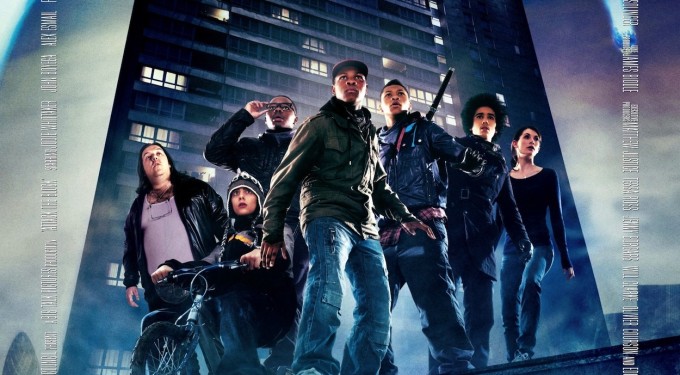
Other than the accents, the thing that may most differentiate British sci-fi pic “Attack the Block,†from its American counterparts is a relative lack of firearms.  It was only a few years ago that the British copper began to carry a gun.  Clubs were sufficient for generations.  Otherwise, American filmmakers could learn something from this contemporary tale of space-alien invasion of Earth.

Like “Cowboys & Aliens,†it has elements of a morality tale.  It also offers suspense, crime, an unlikely band of street rabble forced to save the planet, and a good deal of understated, classically British, comic relief.  It is not, however, a comedy as it is billed.  But it does have “coming of age†elements, which actually work.

Title will make little sense to American auds.  In UK, a “block†can mean many things.  In this case it refers to a subsidized apartment house, what the Brits call a “block†of “council flats.â€Â  The block is turf to two gangs, a group of teen and pre-teen thugs led by Moses (John Boyega), whose weapon of choice is the knife, and whose mode of transport is the bicycle, and a rather more lethal bunch of drug dealers who are a generation older.  The two gangs come into conflict by accident of alien invasion.  Auds can guess which gang lives to tell the story.

Pic opens with Sam (Jodie Whittaker, who played opposite Peter O’Toole’s Maurice in “Venus†a few years ago) about to be mugged by Moses and his juvenile delinquent gang.  The mugging is interrupted by what looks like a meteorite but is in fact a space alien landing on a parked car.  It’s an ugly thing but not quite as awful as the creatures from “Cowboys & Aliens.â€Â  Moses and the gang slay the thing and parade it around as if it were a prop.

All well and good until its mates come looking for it.  These nasty creatures are eyeless, black, hairy blobs who jump higher than an Olympian, scale tall buildings, and tear the guts out of their human victims.

The attack of the killer blobs leads to a couple of plot twists.  First, it brings about an encounter, founded on a misunderstanding, between Moses’ gang and the older drug dealers.  Second, it puts Moses gang into an almost guerilla mode as they flee to safety in the block’s “weed room,†a reinforced indoor greenhouse for growing marijuana.

For all his bravado as a delinquent, Moses is not exactly the bravest of guerilla fighters.  One of pic’s amusing subplots is Moses’ coming of age.  Another amusing subplot is provided by a couple of small kids, aged seven or eight, who show just what a super soaker can do to nasty space aliens.  The main plot, however, as with “Cowboys & Aliens,†lies in the alliance between erstwhile enemies in the face of greater danger.  Sam joins the teen gang.  The girls of the block get involved in fighting the aliens, too.  Even the geek, who come in for special bullying by Moses & Co. provides a critical plot twist and is eventually accepted as one of the in-crowd.  The plot twist is deceptively simple:  It seems, he points out, that the alien slain by Moses is a female.  The hairy blobs are males.  Moses and Co. have the female pheromones all over them.  That is what attracts the hairy blobs.  Auds can figure out the rest as Moses steps up to the plate in an action of almost commando precision.

Pic’s fall guys are the older drug dealers and the cops.  The latter can’t seem to get anything right, even a space alien invasion, which they see with their own eyes.

Unusual for British import, “Attack the Block†can be understood by American ears.  Sound recording is adequate.  Action takes place in one night, which is a money-saving device for filmmakers.  An abundance of night cuts the cost of set design.  Lensing by Thomas Townend is up to par.  Writer-director Joe Cornish helms with a steady hand, and pic is littered with ironic punch lines delivered in deadpan.  How English!  Kudos to Jonathan Amos for keeping pic down to 88 minutes in the cutting room.  Action, which abounds, is convincing, if a tad bloody.  Special effects lack the razzle-dazzle a Hollywood effort would offer, but it is not missed.  The aliens get their point across without it.

“Attack the Block†is rated R, largely for language and violence.  Sex is implicit rather than explicit.  The rating is a joke.  Today’s kids would love it.  Pic offers nothing they have not already seen in a video game.

Ted Faraone

By

2011/07/28 at 12:00am

Cowboys and Aliens (Movie Review)

07.28.2011 | By |

Cowboys and Aliens

Helmer Jon Favreau seems to have found his métier as a director of sci-fi flicks.  That may be good for his bank account, but not so good for auds.  Favreau is a very talented guy who has done just about everything that one can do in film and largely done it well.  A few box office hits in the sci-fi genre with bankable stars in the cast (Iron Man and Iron Man 2) have shown him the light.  It’s not exactly the headlight of an oncoming train at the end of the tunnel, but he could do better.

Cowboys & Aliens, which opens Friday, July 29, is a silly movie.  That is not to say that it isn’t fun to watch.  Even the 1936 propaganda film, “Reefer Madness” (a.k.a. Tell Your Children) offers a degree of amusement.  But watching “Cowboys & Aliens” is akin to ordering from a Chinese buffet menu — One from column A, two from column B.  Pic is a blend of clichés from high-tech sci-fi pix (think “Aliens,” “Priest,” and “Super 8”), a morality tale, and a western, topped off by a sucker-punch to auds delivered by a hummingbird.

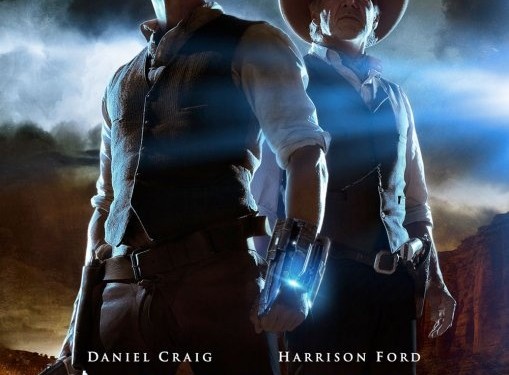
It also stars Daniel Craig as bandito Jake Lonnergan who has a bad case of amnesia and Harrison Ford as former Union Army Civil War Colonel Woodrow Dolarhyde and current local cattleman and padrone of a one-horse town in the wild American West of 1873.  In other words, it was bankable.  Dolarhyde is a greedy bastard who has trouble showing emotion.  He also has a son, Percy (Paul Dano) who is the local bully.  Keith Carradine is perhaps one of pic’s two or three most convincing thesps as the local sheriff.  And Olivia Wilde graces the screen as a good space alien — which explains why her eye makeup withstands explosions, physical attack by bad space aliens, and plunges into deep water.  Max Factor, eat your heart out!  At least she gets a better part than she had in “Priest.”

Throw in a cast of thousands including a plucky kid (Noah Ringer), a loyal dog, a tough-talking minister (Clancy Brown), and an Indian chief (Raoul Trujillo), and a bunch of bad space aliens who look like a cross between the thing from “Super 8” and the acid-blooded creatures from “Aliens,” and shake until the mixing glass is frosty.  You get a movie of sorts.

What little humor “Cowboys & Aliens” offers comes from some deadpanned punchlines uttered by Craig, Carradine, and Brown.  Dialogue is not pic’s strong suit.  Best lines seem to go to Trujillo who allegedly speaks only in the Apache language.

There is a moment in an adventure or crime movie when an experienced filmgoer will say to himself — or to the very attractive and incisive amateur critic seated to his left), “I knew that was going to happen.”

“Cowboys & Aliens” has more than a few.

Pic opens with a wounded Craig waking up in a desolate landscape wearing an odd metal bracelet and being set upon by a trio of bad guys.  He dispatches them with super-human dispatch, a gift which serves him well throughout pic’s 118 minutes.

Arriving in the one-horse town, he dispatches the local bully and gets the attention of gun toting Ella (Wilde) and the sheriff, who recognizes him from a “Wanted” poster.  What Craig doesn’t remember is that he has stolen gold from Ford and that he was abducted and escaped from the bad space aliens.  Evidently amnesia is one of the after-effects of alien abduction.

Just as Craig and Percy the bully (who accidentally shoots a deputy) are about to be handed over to U.S. Marshalls, Ford arrives to spring his kid.  At the same time, the bad aliens attack the town with what appear to be jet fighter-bombers.  In the process they kidnap about half the inhabitants.

The rest of pic centers on a few revelations (Craig’s memory slowly returns thanks to Ella and some Indian mysticism) and the need for banditi, greedy guys, a good space alien, and the Apache to join forces to defeat the aliens before the planet is taken over for its gold deposits.  The bad space aliens arrived on a rocket-powered space ship which contains both gold mining and refining equipment.  Like Nazis, they even pull the gold teeth from their captives.

Ending is totally predictable.  Harrison Ford’s shell cracks.  The “Wanted” poster is forgotten.  The bad aliens appear to be dispatched, some good guys die heroic deaths, and the plucky kid comes of age early.

Pic’s sucker punch comes in the form of a hummingbird, a special-effects hummingbird, no less, connected to Ella, which appears to Craig first as he regains his memory and again in the final reel only to scream a figurative “sequel!”

“Cowboys & Aliens” offers more than a few good action scenes.  Special effects, save the bad aliens, are not bad.  Best effect is Wilde emerging buck naked from a funeral pyre set for her by the Apache.  In order to keep pic’s PG-13 rating Craig covers her with an Indian blanket before any more than her fine backside appears on screen.  Have no fear in taking the kids.

The morality tale, utterly politically correct in today’s climate, is that greedy people have to set aside their greed and unite with their erstwhile enemies for the common good.

A final note:  “Cowboys & Aliens” boasts a list of writers, producers, executive producers, and production companies almost as long as its cast of thousands.  With that many cooks, it is no wonder that the stew verges on mish-mash.

Ted Faraone

By

2011/07/21 at 12:00am

Friends with Benefits (Movie Review)

07.21.2011 | By |

Friends with Benefits

It is sometimes amazing to see a well-worn Hollywood formula repackaged for the umpteenth time and still work.  Such is the case of “Friends with Benefits,†a star vehicle for Justin Timberlake (art director Dylan) and Mila Kunis (headhunter Jamie).  Before the opening titles there are two breakups:  Dylan’s girl in LA dumps him and Jamie’s boyfriend in New York dumps her — just as both are dragging their tardy guys to their favorite chick flicks.  Via a cute bit of editing (kudos to Tia Nolan) auds are led to believe briefly that it is one breakup — Dylan and Jamie — until the bi-coastal synchronicity sets in.  Both battle scarred veterans retire from the field.  No more romance for them.
 
Jamie lures Dylan to New York for a job interview to be the new art director of GQ Magazine.  He aces the interview.  The pair become fast friends — as in we like each other but there’s no sex.  That changes when Jamie utters, “God!  I want sex.â€Â  Can two great friends have a sexual relationship that is “no relationship, no emotions, just sex, whatever happens?â€Â  Auds will quickly figure out the answer.  As Stephen Sondheim wrote in one of the lyrics to A Little Night Music, eventually the nets descend.  The questions for “Friends with Benefits†are “How long will the arrangement last?â€, “When will the nets descend?â€, and “What happens after the inevitable breakup?â€
 
While skein is busy answering said questions, pic reveals itself as a valentine to New York City, which is as much a character as any of the cast.  In the opening reel Jamie takes Dylan on a tour of New York to sell him on leaving LA.  It’s full “fish out of water†Angelino in Gotham jokes, but it works — both cinematically and as a plot device.  Dylan is sold.  Good thing, too, because by the time they get to the “just sex†part, pic is on to its second reel.
 
It’s nice to see Timberlake in a non-smarmy role, which he handles convincingly, but it is Kunis who steals her scenes as the tough, fast-talking, wisecracker.  Supporting roles are notable.  Patricia Clarkson does a star-turn as Jamie’s goofy, ex-hippie mom wherein there is a running gag about the nationality of Jamie’s dad.  Woody Harrelson has the unenviable task of being comic relief in a comedy.  His over-the-top gay sports editor sports more cliché gay jock jokes than your critic imagined exist.  To his credit, he plays the role big, bold, and farcical — think of Zach Galifianakis minus the annoying aspects.  Richard Jenkins as Dylan’s dad suffering the early stages of Alzheimer’s Disease and Jenna Elfman as sister Annie anchor pic’s serious scenes.  Jenkins comes across as sympathetic rather than pathetic.  Elfman has the least to work with but does well with what scribes Harley Peyton, David A. Newman, Keith Merryman and Will Gluck (who also directed) give her as the primary caregiver for dad and her son, a ten-year-old tuxedoed magician (Nolan Gould) whose trick failures are another one of pic’s myriad running gags.  In this regard “Friends with Benefits†bares careful scrutiny.  There are no loose ends.  Everything that happens in the picture happens for a reason and will probably happen again to move the plot along — or at least leave auds saying, “I knew that was coming.â€Â  Sharp-eyed viewers will notice Paul Mazursky’s 1969 sexual revolution comedy, “Bob & Carol & Ted & Alice,†unspooling on a TV in the background of one scene.  It is one of pic’s many inside-film references.
 
Plot hinges on the overheard conversation, a truly shopworn device, but it gets the point across.  Jamie, unseen by Annie and Dylan, listens to Dylan argue with his sister that there is no relationship between Jamie and him; that the girl is damaged goods.  This leads to the inevitable breakup which takes place on Independence Day weekend at Dylan’s oceanfront boyhood home in what appears to be Santa Barbara.
 
Rest of pic’s 109 minutes are spent keeping auds guessing whether it will end as a romantic comedy (“Before Sunsetâ€) or a weeper (“The Break-Upâ€).  Dénouement’s impetus comes from two characters both unlikely given their backgrounds and at the same time very likely given Hollywood tradition:  The parents.  Jenkins’ Mr. Harper in a lucid moment, punctuated by a perfectly timed gag, clarifies Dylan’s thinking.  Goofy, unreliable Lorna (Clarkson) does likewise for Jamie.  This plot trick has been done to death, but here it enjoys a resurrection.
 
“Friends with Benefits†is rated R.  For once the R rating is right.  There’s plenty of language and some pretty hot sex.  Children won’t understand it.  However, for adults it offers good lensing, adequate sound, and about a laugh a minute — even in the serious scenes.

Ted Faraone

By

2011/01/25 at 12:00am

SAW 3D

01.25.2011 | By |

Rating: 1.0

Rated: R for sequences of grisly bloody violence and torture, and language.
Release Date: 2010-10-29
Starring: Patrick Melton & Marcus Dunstan
Director(s):
Distributor:
Film Genre:
Country:USA
Official Website: http://saw3dmovie.com/

 Go to our film page

 

James Frey, whose fictional autobiography, “A Million Little Pieces,†got him roasted on Oprah Winfey’s sofa for 48 minutes, got off easy compared to Bobby Dagen, ably played by Sean Patrick Flanery, who is tortured (along with the audience) for 90 minutes for concocting a fictional best seller about surviving the Jigsaw killer in “Saw 3D†or “Saw VII†— depending on one’s point of view.


Horror thriller’s plot is simple.  The late Jigsaw John (Tobin Bell) who appears in flashback, had an accomplice, which everyone who saw “Saw VI†knows is crooked Detective Mark Hoffman (Costas Mandylor) whose career has not exactly soared since his stint on David E. Kelly’s “Picket Fencesâ€.  He may be best remembered by some as the fellow in HBO’s TV series, “Sex and the City,†with a male part too big even for Samantha (Kim Cattrall) to handle. 


Bobby Dagen is raking in cash on his book tour.  Hoffman gets upset about this (why is anyone’s guess) and sets out to right matters.  He also has a beef with Jigsaw John’s widow, Jill (Betsy Russell), who has fingered him to the cops as her late husband’s accomplice and tried to kill him.  At least that makes sense.


Like the rest of the Saw series, “Saw 3D†relies on about one dead body every ten minutes, cheesy special effects, and relentless villains to achieve suspense.  The vics are also not guilt free.  They mostly (with a few exceptions) did something bad…. In other words, they’re human. 


This alleged thriller relies on an extraordinary suspension of disbelief.  Hoffman’s traps depend on perfect timing, amazing mechanical perfection, and a puppet showing up on TV at exactly the right moment to move the plot along.  The money such a setup would cost would be far beyond the means of a policeman.  It would be the kind of cash that would make Fed Chairman Ben Bernanke apoplectic. 


By now everyone who knows anything about the Saw franchise knows that its central premise is that life is about choices.  Unfortunately for those caught in Jigsaw’s traps, said choices are Hobson’s on steroids.  Pic’s second scene is set in an urban storefront in which two guys, both dated by an attractive women held overhead in a sling which emphasizes her most excellent endowments, are chained to circular saws.  In order to save the girl, one of them must saw the other to death.  If they save each other, the girl gets sawed to death.  This is classic Saw.  It is also a tad unfortunate since the unaccredited actress is sort of righteous.


“Saw 3D†also plagiarizes other works.  Hoffman stitching his face after Jill’s alleged murder attempt is straight out of Spanish pic “Pan’s Labyrinth.â€Â  A bit in which Bobby has to shove hooks into his pectoral muscles was used to much better effect by Arthur Kopit in “Indians,†both on stage and on screen.


3D is a gimmick that Hollywood tried about 50 years ago.  It coincided with the Hula Hoop.  There is nothing new under the sun gear, as “Road & Track†magazine founder John Bond said.  Hollywood is reviving the gimmick to get bodies to shell out money to see subpar films.  It will work for a while.  Thus far your critic has seen only one picture that benefitted from 3D:  It is “Despicable Me†(which is reviewed on this site).  Heck, even CBS Sports is toying with 3D to get folks to watch its depleted roster on television.  Note to programmers:  3D does not make up for crummy material.  A compelling work can be shown on a 13-inch black and white TV screen and hold one’s interest, if not one’s breath.


Helmer Kevin Greutert was an editor on many of the Saw pictures and directed “Saw VIâ€.  Tech credits, save for the cheesy special effects, are adequate.  So is sound recording, although “Saw 3D†could be a silent picture and be none the worse for it.  Dialogue is at best banal.  Performances are almost universally awful.  Only Flanery rises above the material, which is not saying much.


“Saw 3D†is billed as the end of the Saw franchise. That would be a good thing.   With No. 7 it has jumped the shark.  But your critic fears otherwise.  Pic leaves a number of dangling participles on any of which can be hung “sequel.â€Â  Auds do not know if Bobby dies or if Hoffman dies.  And it is revealed that Jigsaw John had a second accomplice, a blond haired physician (Cary Elwes) who cauterized his stump after amputating his own leg — pic’s opening scene.  Near pic’s end it is revealed that Jigsaw John made the guy his “executor†of sorts.  The future will depend on the box office that “Saw 3D†does.


Released just in time for Halloween, “Saw 3D†is rated R according to its press materials “for sequences of grisly bloody violence and torture, and language [sic].â€Â  Take a pass.  Put the Jigsaw guys out of their misery.

Ted Faraone

By

2010/12/14 at 12:00am

The Other Guys

12.14.2010 | By |

Rating: 4.0

Rated: PG-13 for crude and sexual content, language, violence and some drug material.
Release Date: 2010-08-06
Starring: Adam McKay & Chris Henchy
Director(s):
Distributor:
Film Genre:
Country:USA
Official Website: http://www.theotherguys-movie.com/

 Go to our film page

“The Other Guys,†like almost every good pic in which Will Ferrell has starred, is  a vehicle for his comic genius.  The plot is preposterous.  There is adequate vulgarity to please teenage boys.  The jokes are broad — so broad that they are farcical, and several of them are running gags.  Pic marks the first pairing of Ferrell with Mark Wahlberg.  It’s a happy combination.  The pair have the chemistry of classic comedy teams such as Laurel & Hardy, Abbot & Costello, and Martin & Lewis.  Ferrell and Wahlberg are NYPD detectives Allen Gamble and Terry Hoitz.  They are an unlikely pair, even for a buddy-pic comedy.  Gamble is a forensic accountant.  Hoitz is best known as the cop who shot Derek Jeter by mistake (who appears in a cameo) and cost New York a World Series.  The punchline is, “You couldn’t have shot A-Rod?â€Â  Hoitz is the little macho sparkplug, full of anger at himself and embarrassed to be partnered with Gamble, whose chipper attitude annoys him.  Michael Keaton is the precinct captain, who works nights as a manager at Bed Bath and Beyond to pay his bi-sexual son’s tuition at NYU.  What the heck are these two doing in a precinct?  What the heck are these two doing as cops in the first place?  They are the buffoons of the precinct, dumped on by the other cops.  They are “the other guys†to the PD’s stars.


Pic has roots in sketch comedy, and it shows.  Ferrell and helmer Adam McKay, who shares screenwriter credit with Chris Henchy and Patrick Crowley, are veterans of TV’s “Saturday Night Live.â€Â  Plot strings together the sketches.  Ribbon on the package is narration by Ice-T which borrows heavily from TV’s “Law & Order†franchise.


Premise is simple.  Hoitz itches to redeem himself by cracking a big case.  Gamble would rather do paperwork, run numbers, and track down permit violations.  The diminutive Wahlberg holds his much taller partner in contempt.  The pair are overshadowed by New York’s hero cops, Highsmith and Danson (Samuel L. Jackson and Dwayne Johnson in parodies of other action hero roles they have played).  Highsmith and Danson are sort of Starsky and Hutch on steroids.  In the first two reels they wreck two 1971 Chevelle SS muscle cars which had been in perfect condition — as well as countless other automobiles.  The swaggering pair are got out of the way by a bizarre suicide:  They jump off a 20 storey building chasing bad guys.


Hoitz determines to replace them — even with Gamble as his partner.  Gamble stumbles on missing scaffolding permits which he ties to a Bernie Madoff sort (David Ershon played by British actor Steve Coogan).  What he doesn’t know when he arrests Ershon on the permit violations is that he has just walked into a $32 billion scam involving a hot blonde (Anne Heche), Chechens, Nigerians, and a mean security man with an Australian accent (Roger Wesley played by Ray Stevenson) who is very tall and very deadly.  Rest of pic hinges on Gamble and Hoitz’s ill-starred attempts to crack the bigger case.  This sets up pic’s running jokes, including references to a couple of bands popular in the 1970s (The Little River Band gets significant time on pic’s soundtrack) and Gamble’s odd irresistibility to extraordinarily hot women.  Helping drive the latter point home is the stunning Eva Mendes as his loving wife, Dr. Sheila Gamble, a cameo in which Brooke Shields hits on Gamble, a bit with Natalie Zea as Gamble’s ex-girlfriend, Christinith, a name which sets up yet another joke, and a walk-on by smoking hot newcomer Pilar Angelique.  Zea’s bit is actually a real plot twist in solving the crime.  One has to give McKay credit for keeping pic’s surreal 107 minutes on track while maintaining the screwball farce.


Pic also benefits excellent stunts and special effects, flawless timing from the principals, fine screenwriting for its genre, and editing by Brent White which is as disciplined as Ferrell’s comedy.  A word on the latter:  Will Ferrell off screen is not a funny guy.  He works at comedy the way Lucille Ball did, the way Fred Astaire worked at dance.  He succeeds.  Other tech credits shine.


Pic’s PG rating is largely due to today’s obligatory vulgarity and to one of the funniest scenes ever filmed since Alan Arkin and Peter Falk teamed for “The In-Laws.â€Â  (Anyone remember “Serpentine, serpentine!â€?)  While the bad guys are watching his house, Gamble hides outside and phones in an attempt to reconcile with Dr. Sheila, who has thrown him out.  Their go-between is her mother, Viola Harris as Mama Ramos, who relays unbelievably steamy messages between the pair regarding three days of make-up sex.  That scene is so funny that one initially ignores its utter implausibility.  “The Other Guys†is a laugh a minute.  Take the kids.  They’ll fail to understand why the foregoing scene is so funny, but they won’t be exposed to anything that will corrupt them.

Ted Faraone

By

2010/11/10 at 12:00am

The King’s Speech (Movie Review)

11.10.2010 | By |

The King's Speech

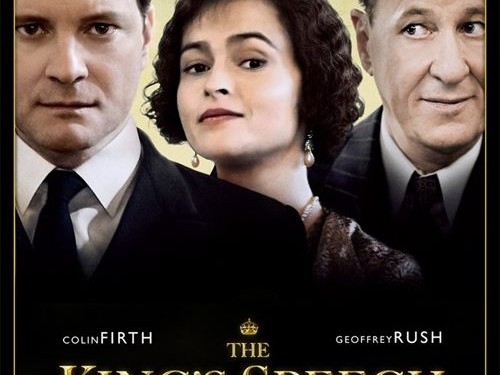
There are several delicious ironies about “The King’s Speech,” billed as an historical drama and directed by Tom Hooper from a screenplay by David Seidler.  The first is the title.  The King’s Speech is given at the opening of the British Parliament.  To your critic’s knowledge, it has been The Queen’s Speech since 1952, when Elizabeth II ascended the throne following the untimely death from lung cancer of her father, King George VI, one of pic’s principals ably played by Colin Firth.  Since the next three in line for the throne today are men, the Speech is likely to be the King’s again.  George VI had a terrible stammer, which made it difficult for him to perform many of his public duties as Duke of York, younger brother of David, the Prince of Wales, who would later become Edward VIII, Duke of Windsor.  The latter is played by Guy Pearce in a rather one-dimensional portrayal of a self-indulgent royal.  George VI, who had a more down-to-earth understanding of his duty, was known as Bertie to his family.  His wife is a legend of 20th Century Britain, Lady Elizabeth Bowes-Lyon (Helena Bonham Carter), who, when she was still the Duchess of York, set out on her own to find a speech therapist for her husband.  This brings up pic’s second delicious irony:  Helena Bonham Carter is the great-granddaughter of Herbert Henry Asquith, English Prime Minister from 1908 to 1916, the first prime minister to serve under George V (played here by Michael Gambon), father of pic’s subject, and great niece of Violet Asquith, a Liberal member of Parliament for many years and close friend of Winston Churchill, who is played by Timothy Spall in a less than ideal bit of casting.  The goings on in this pic had to be gossip at her family’s dinner table.  For those who care, the shapely Carter was most certainly padded to play the matronly Elizabeth, who, during pic’s action, never passes her 40th birthday.


The Duke of York put little stock in speech therapy.  Treatments of the day (Pic’s action covers the period from the mid 1920s to the outbreak of war in September 1939) were both appalling and humiliating.  One doctor even advised the Duke that smoking cigarettes relaxed the throat and calmed the nerves.  It was no surprise that when the Duchess finally encountered Australian ex-pat speech therapist Lionel Logue (Geoffrey Rush, who also gets executive producer credit) that the Duke offered resistance.  Logue’s methods were unorthodox to say the least.  He is self-taught, a former actor, who got into speech therapy helping traumatized Australian soldiers returned from the First World War.  There was no textbook.  He had to make it up as he went along. 


Now enters the buddy-film aspect of this period piece.  Logue won’t treat the Duke unless the His Royal Highness submits to his rules on his turf.  He insists that the Duke call him Lionel and that he will call the Duke “Bertie.”  The Duke grudgingly submits to acting as the social equal of his speech coach.  Unwilling to divulge much private information, the Duke does admit that his stammer began around age four or five and that his father, the King, encouraged his brother David to tease him about it.  Michael Gambon’s George V is the gruff, remote father and family man of the history books.  But as King, he has learned one important modern lesson:  Radio has turned royalty into actors.  His annual Christmas broadcast to the Empire drives the point home.  His advice to Bertie is like a Nike slogan barked by a drill sergeant.


A friendship between King and subject can never be normal, no matter how high the regard each holds for the other.  The dynamic between Rush and Firth captures this delicate balance.  In matters of speech, Logue is in charge.  His methods include exercises, encouragement, and provocation.  Provocation proves to the pupil that the stammer has a non-physical component:  When his temper is aroused the Duke spits out words in continuous flow.  But when Logue steps over the line, more out of enthusiasm for his pupil’s ability than anything else, the Duke accuses him of treason and cuts him off.  His offense?  With George V having passed, David has become King, and he is making a mess of the job.  The abdication crisis of 1936 looms, and Bertie is next in line.  David has already teased him about wanting to usurp the throne, an idea that Bertie abhors.   The last thing he wants to be is chief of state in an era when the chief of state has to speak in public.  Logue’s enthusiasm (“You can outshine David”) in that instant is impertinent and incisive — too incisive.  Logue’s attempt to apologize is rebuffed.  Give helmer Hooper credit for knowing how to use the close-up to good effect with pros like Rush and Firth. 

Eventually, with a coronation to perform, Bertie (now George VI), recalls Logue to his service.  A scene in Westminster Abbey with Derek Jacobi as a presumptuous Archbishop of Canterbury reveals the esteem in which Bertie is held by the British establishment.  Zero.  He is accorded deference because of his position.  His years of stammering and failed public appearances have cost him respect.  His courtiers think they can manipulate him.  Thanks to Logue’s help in mustering the courage he had as a naval officer in the First World War, George VI overcame what studies say is the greatest fear people in civilized nations face:  the fear of public speaking.  In overcoming that fear he became the King whose grace under pressure during the bombing of London inspired a quarter of the world’s population to resist the Axis.  Logue would continue to assist the new King in rehearsing all his wartime broadcasts, and he was rewarded in 1944 with an honor for service to the monarch.  The King, who most certainly was unaware of it, also inspired a young Australian boy who also had a stammer.  The boy listened to the King on the radio and thought, if the King can beat his stammer, so can I.  After almost 50 years writing for film and TV, David Seidler would write pic’s screenplay.  He was fortunate to have the cooperation of Logue’s descendants, who kept many of his period diaries.  He was also fortunate to have the cooperation of King George VI’s widow, by then the Queen Mother Elizabeth, who asked only that the film not be made until after her death — the memories were too painful.  It was a long wait.  She lived to be 101.  The rest is history.


It is impossible to delve into the entire nuance “The King’s Speech” packs into 118 minutes.  Pic is rated R due to language.  It seems that profanity trips off the tongue of the stutterer with ease.  But it would be a mistake for readers to think that “The King’s Speech” is entirely without comic relief.  Logue repeatedly snatches cigarettes from his star pupil as the latter is about to light them.  It would have been to George VI’s advantage to heed him and kick the habit.  A scene in which Myrtle Logue (Jennifer Ehle) arrives home unexpectedly early only to find the Queen taking tea in her dining room is priceless.  It is at pic’s ending that its neatest irony unfolds.  It follows George’s radio broadcast to the Empire at the outset of war.  It may be a tad difficult to believe, but it is true.

Select a Page