01.14.2013 | By Jack Rico |
*Updated April 2026
With Ben Affleck’s Argo winning big at the 2013 Golden Globes, another film also set the stage for an auspicious Oscar night. Universal Pictures’ Les Misérables took home Best Picture and Best Actor in the Musical/Comedy category, alongside Best Supporting Actress for Anne Hathaway. These were major victories, especially knowing that Harvey Weinstein was aggressively pushing Silver Linings Playbook to the Hollywood Foreign Press Association.
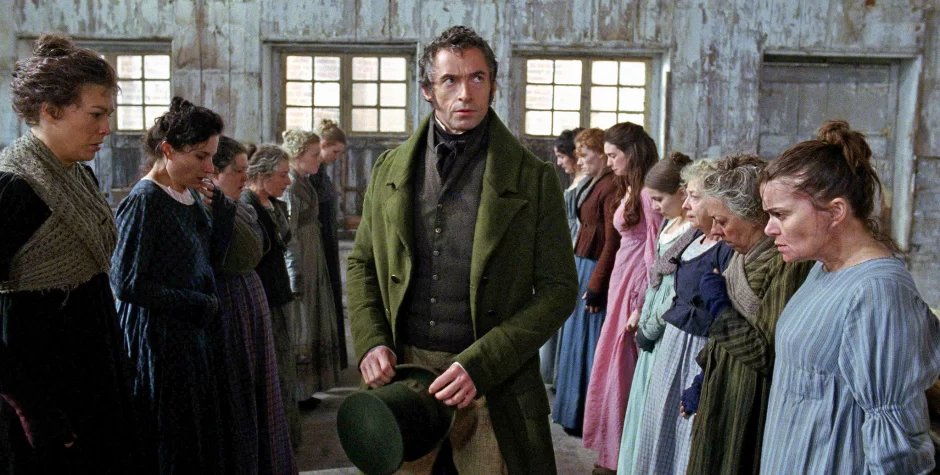
Based on what is widely considered one of the greatest novels of the nineteenth century, Victor Hugo’s French book is set against the backdrop of an era steeped in revolution. It tells the enthralling story of broken dreams, unrequited love, passion, sacrifice, and redemption. Hugh Jackman plays ex-prisoner Jean Valjean, hunted for decades by the ruthless policeman Javert (Russell Crowe) after he breaks parole.
When Valjean agrees to care for factory worker Fantine’s (Anne Hathaway) young daughter, Cosette (Amanda Seyfried), their lives change forever. There are many things to consider when contemplating Tom Hooper’s cinematic adaptation of Les Misérables. It is nearly three hours long and the words are sung for the entirety of the picture without any spoken dialogue.
That format is something many people are not used to and it can be polarizing at first. However, this is a cinematic masterpiece drenched in powerful performances, stunning cinematography, and a haunting score sure to provoke tears. You must also remember that Tom Hooper directed The King’s Speech, which won the Oscar for Best Picture, Best Director, Best Actor, and Best Original Screenplay.
He now has the pedigree to deliver pure gold. Without further delay, here are four reasons why you absolutely need to see this theatrical triumph.
A Timeless Story Rooted in Human Struggle
We see how much suffering Hugh Jackman’s character endures throughout the narrative. He believes Victor Hugo wanted to remind people to love, an idea he feels is relevant and necessary in modern times. True love and self-realization come from being present and facing what is right in front of you.
Anne Hathaway plays a woman forced to find the means to send her sick daughter money for medicine. She realized her character is not merely a woman from 19th-century France, but someone who could be living right down the street today. The injustice exists in our modern society, so she approached the role as an honor to the real women facing similar hardships.
The actress prepared for her part by watching video clips and reading articles about women forced into prostitution or sex slavery. For her, it was an inspiration to give a voice to these marginalized individuals. This powerful outlook provides the picture with a visceral sense of contemporary social awareness.
Her character isn’t the only one showing how timeless this narrative remains. Eddie Redmayne plays a student hungry for revolution as a way of changing the putrid society they live in. He noted that all you had to do was open a contemporary newspaper to see equivalent protests happening in New York or the Middle East.
This idea of young people lighting a flame to try to expose the truth resonates deeply across the board. Director Tom Hooper expanded on this when pondering if this was the right time to bring the story to the big screen. He believes Les Misérables is the great anthem of the dispossessed, carrying an inspiring message that we can all collectively rise up to better our situation.
Extreme Physical and Emotional Dedication
Hugh Jackman is Jean Valjean, prisoner 24601, who has been used for slave labor for nineteen years. We meet him just as he is being released, completely unrecognizable physically. Jackman mentioned the director wanted to show the passage of time, and if people didn’t start asking if he was sick, he was not doing his job right.
He lost a massive amount of weight before undergoing a grueling thirty-pound physical transformation for the later scenes. Still, he believes this was nothing compared to what Anne Hathaway accomplished. She lost roughly 25 pounds in just two weeks to accurately portray a woman dying of consumption.
Not only did she drop the weight at a fast pace, but she also had a professional hairstylist cut her beautiful long hair on camera. Jackman joked about overhearing Hathaway tell Hooper that if he cut her scalp and she bled, they should keep rolling. Hathaway offered to cut her own hair because she knew the authentic suffering it would communicate to the audience.
She knew the haircut was in the script and thought doing it for real might raise the emotional stakes. Hathaway also made sure to praise her co-star’s dedication. She urged audiences not to let Jackman’s friendly public persona distract them from his profoundly gifted, serious acting.
The Raw Power of Live On-Set Singing
Tom Hooper insists that Hathaway’s singing is absolutely fantastic, possessing an utter feeling of naturalness that puts viewers at ease. The main goal for the production was to find actors comfortable communicating through song so the audience never feels a need for dialogue. Every single actor had to pass a rigorous three-hour audition, regardless of their Hollywood status.
This proved they could sing live and communicate instinctively, making sure everyone knew the monumental task ahead. Hathaway is a soprano who trained with her vocal coach for six months to learn how to sing with raw emotion while keeping her face firm. She practically practiced crying and singing simultaneously so she would be ready to capture the moment live on camera.
Hugh Jackman is no stranger to stage musicals and utilized his one-man show to prepare for Les Misérables. Hooper could not be more thrilled to have him on board, noting his ease and charisma are incredibly rare. The most historic addition is a brand new song created exclusively for the film called “Suddenly”, which plays when Valjean first meets Cosette.
Jackman reminds us that this song propels the second half of the movie, anchoring one of the most dramatic moments ever written. It was genius for the director to bring the original theater team to help craft this number. Meanwhile, Amanda Seyfried leaned on her teenage voice lessons and opera studies to deliver her impeccable high notes.
She felt so comfortable that she often forgot she was singing her emotions instead of speaking them. Samantha Barks, a professional singer who played Éponine in London, found taking over the role for the screen to be a massive honor. She noted that the realism of crying live on camera adds an intense, intimate emotion to her voice.
An Oscar-Winning Visionary at the Helm
Tom Hooper knew the huge responsibility he faced adapting a musical beloved for over 26 years. He understood that the central hook is experiencing strong emotions, so he utilized uncomfortably tight close-ups during the musical numbers. This created a highly visceral connection between the weeping actors and the audience.
Bringing the original theater creators to the set helped the cinematic adaptation stay incredibly close to the source material. Hooper also included specific visual metaphors from Victor Hugo’s book, such as using a damaged warship to represent the vulnerability of state power. He found that showing the gritty details of the barricade battle on film would be deeply exciting.
The cast themselves became extremely close, frequently hanging out after shoots and communicating entirely in song. Hathaway confirmed the whole cast was made up of massive theater geeks who deeply understood the legacy entrusted to them. Their passion for music linked them together, leading to Hathaway and Barks singing duets from Rent in their free time.
Eddie Redmayne said the mixture of the theater world and film world felt totally original. The environment constantly inspired everyone to do the absolute best work possible. Jackman closed off by sharing that it felt like the closest stage show he had ever been involved in, but it was captured on film.
If you are on the fence about seeing Les Misérables, know that Hollywood simply does not make this type of spectacle anymore. When they do, they are rarely made with this caliber of production value or raw acting talent. You are in for a cinematic experience for the ages, and it rightfully deserves its place in Oscar history.