News Headlines


Frankenstein (Movie Review)
02.14.2026




10.2.2009 | By Ted Faraone |

*Updated April 2026
The brothers Joel and Ethan Coen have brought an amazing variety of films to the screen over the last 25 years. From the over-the-top Blood Simple to the extraordinarily annoying Fargo and the superbly funny Burn After Reading, they have at last decided to make a serious picture. A Serious Man is a drama in disguise, performed by comedic actors.
That does not make it a bad movie. It just makes it difficult to review, especially since every other notice seems to blindly follow the press notes. Working for the Coens is almost a rite of passage for top-tier Hollywood talent.
A Serious Man is an anomaly because there are only two publicly recognizable names in the cast. Fyvush Finkel appears only in the opening reel, and Richard Kind ably carries about a fourth of the film. The remainder of the cast turns in excellent, if annoying, performances.
It is a credit to the directors that they found such great, inexpensive talent for a reported $7 million budget. The performances are annoying because of the picture’s very nature. It is fundamentally about annoying people.
A Suburban Schlemiel Surrounded By Chaos
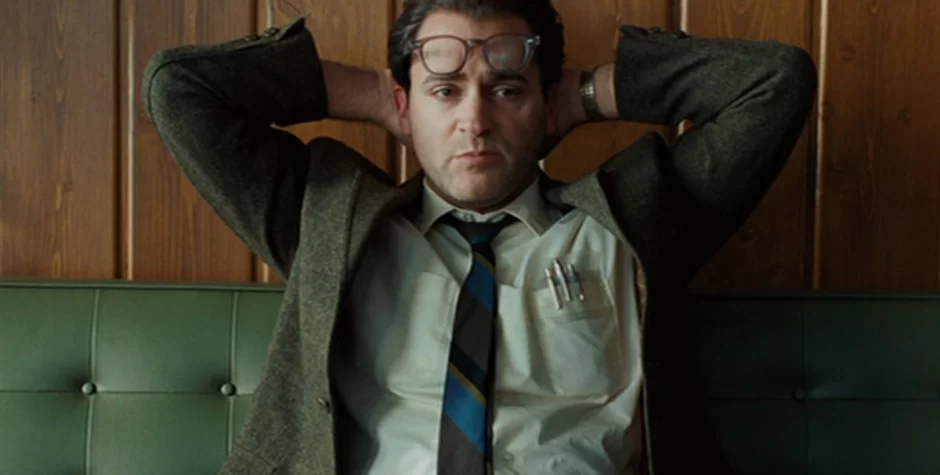
Set in a suburban Midwestern Conservative Jewish community in 1967, the story centers on college professor Larry Gopnik (Michael Stuhlbarg). Larry is the film’s schlemiel, the fellow on whom the soup is spilled. Gopnik is surrounded by schlimazels, the folks who spill the soup.
They include his wife (Sari Lennick), who leaves him for passive-aggressive neighbor Sy Abelman (Fred Melamed). He also deals with his kids and his brother Arthur (Richard Kind), a mathematical genius with tendencies toward moral turpitude. Gopnik’s quest is simply to find out why his luck stinks.
A real answer to such a question could function on interminable levels and still leave the questioner dizzy. Instead, the film takes a route well traveled by Woody Allen in Crimes and Misdemeanors and author Isaac Bashevis Singer. The twist is that it is loaded with comedic moments, almost as if the filmmakers were winking at the audience.
The Transistor Radio Rosetta Stone
Gopnik is stymied at every turn, unable to get advice from anyone, not even the elderly senior rabbi at his synagogue. Everyone else either talks over him or at him to manipulate his choices. His kids have their own agenda, and nobody communicates.
A subplot involving the pothead Bar Mitzvah boy who owes his connection money is the film’s Rosetta Stone. The boy tucks a $20 bill into his transistor radio case, which the Hebrew school teacher immediately confiscates. The boy lives in fear until his ceremony.
The resulting sequence makes for one of the funniest stoned-out-of-one’s-mind Bar Mitzvah scenes in cinema. It owes a bit to the wedding in The Graduate for its brilliant guest reaction shots. After the ceremony, the boy meets privately with the elderly Rabbi Marshak (Alan Mandell).
The old man quotes a Jefferson Airplane tune, asking the boy what he will do when everything goes wrong and there is no hope. He then hands him his transistor radio with the $20 bill still tucked inside. It is the most honest moment in the film, similar to the existential revelations in Husbands and Wives.
An Existential Prism Through A Suburban Lens
A Serious Man excels in performance, cinematography, set design, and dialogue. The editing and direction are economical, except for the opening reel. That opening begs the question of whether this family is cursed or if it has nothing to do with anything else.
These loose ends both serve a point and annoy the viewer. We learn that life happens and one has to roll with it. We also learn that schlimazels are not immune to bad luck.
One might wish the Coens could have tied it up in a tighter package or used a lighter touch. However, there has been unwarranted criticism of the film’s seemingly negative focus on a Jewish community. The community is simply the context the Coen brothers know best.
The message is better told through this intellectual prism. It could equally have been told through a French existentialist lens, but American audiences might reject that. At least viewers reared on sitcoms can understand it.