News Headlines


Frankenstein (Movie Review)
02.14.2026



08.21.2009 | By Jack Rico |

*Updated 2026
In 2026, when Quentin Tarantino’s style is still debated as much as his stories, Inglourious Basterds remains a test of whether bravura scenes can survive the director’s self-consciousness.
Inglourious Basterds is a collection of brilliantly crafted scenes, often interrupted by Quentin Tarantino‘s ego. Concerned that we might forget who’s directing, he reminds us constantly that this isn’t any old World War II film. The movie could have been one of the great cinematic works of this decade, if not for Tarantino’s compulsion for attention, which overshadows the craft and the audience’s experience.
Set in Nazi-occupied France during World War II, the film follows a group of Jewish-American soldiers known as “The Basterds” (Brad Pitt, Eli Roth, Til Schweiger). These men are chosen to spread fear throughout the Third Reich by scalping and killing Nazis. They soon cross paths with a French-Jewish teenage girl (Mélanie Laurent), who runs a movie theater in Paris that becomes a target for the soldiers.
Quentin Tarantino’s Stylistic Evolution in Inglourious Basterds
Don’t expect Kill Bill. This is Tarantino’s new evolution, a director who has grown in every way, except as a storyteller. The film is supposedly about Nazi killers during WWII, but it’s really about the love of cinema—Tarantino’s love of cinema.
“Can it be?” you might ask. That’s exactly what I thought when the movie ended. The constant dialogue references to French and German classics are unavoidable, but regrettably, they disrupt the pace of the film in their effort to pay homage.
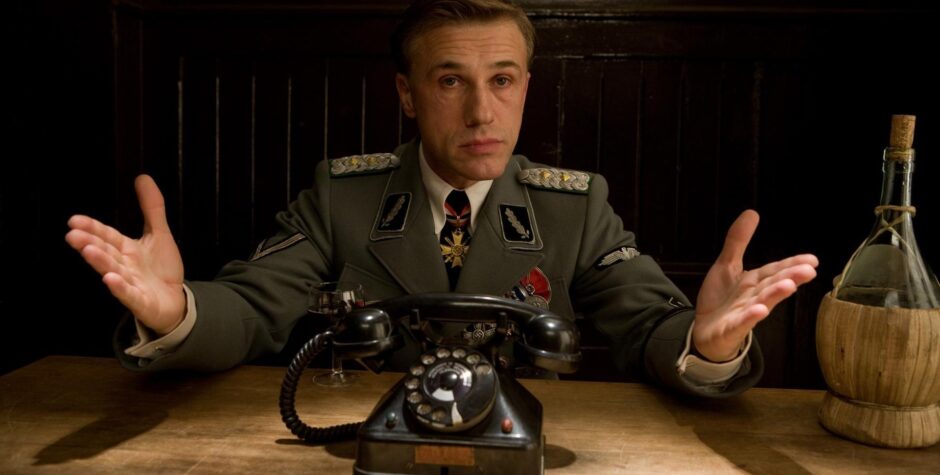
As a result, the audience is taken for a bit of a switch-and-bait experience. The crazy part is that it’s a delightful switch-and-bait. Expect a beautiful, meticulously crafted visual cinematic experience, highlighted by an Oscar-winning performance from Christoph Waltz as Col. Hans Landa and potentially Mélanie Laurent as well.
Why Christoph Waltz and the Basterds Performance Succeeds
The opening scene is riveting, one of the most memorable sequences Tarantino has ever put on screen, rivaling Pulp Fiction. It’s elegant, sophisticated, tense, and engrossing. However, at times, the film falters, slipping with miscasting choices and a somewhat anticlimactic ending.
RELATED: Gran Torino (Movie Review)
We witness a director trying to find himself as the film unfolds. It’s not particularly admirable, but it’s certainly interesting.
What you’ll appreciate about Inglourious Basterds is its compelling story concept, artistic cinematography, and Waltz’s mesmerizing and terrifying performance. What you might not like is that you paid to see a movie about Brad Pitt killing Nazis, but instead, you get a film about the romanticism of world cinema. This cinema analysis proves that Tarantino is always his own favorite subject. Go figure.
RELATED: Kick-Ass (Movie Review)