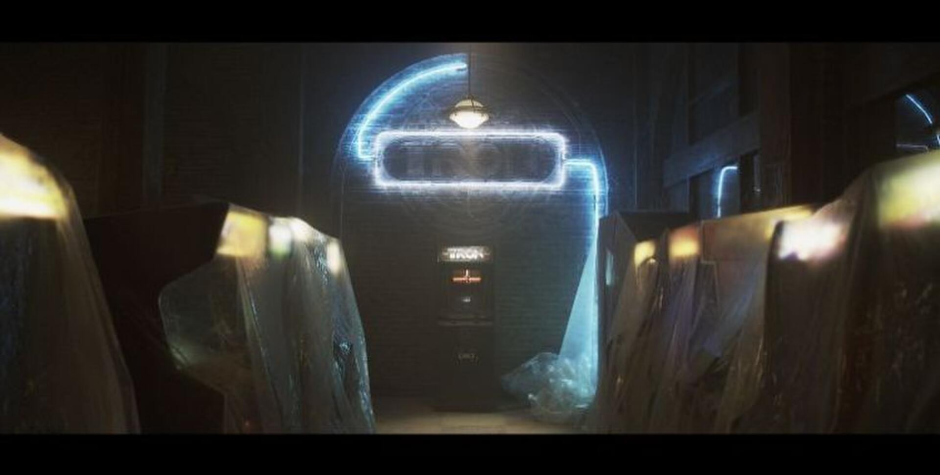
We recently attended a 20-minute sneak peek of Disney’s Tron: Legacy months before its theatrical release. The presentation offered an in-depth look at how the visual effects, costumes, and vehicles were brought to life. This project is significant as it follows the footsteps of the 1982 cult classic Tron.
The film marks several cinematic milestones, including the first use of a Helmet Mounted Camera in live action. It also features Jeff Bridges playing opposite a younger digital version of himself. Developed by Digital Domain, the 3D imaging represents the most advanced technology available since Avatar.
In the original Tron, Kevin Flynn is a software engineer whose work is stolen by Ed Dillinger, played by David Warner. Flynn is eventually digitized into a computer world where programs resemble their creators. Alongside the security program Tron, he defeats the Master Control Program to reclaim his company, ENCOM.
Tron: Legacy picks up years later, revealing that Flynn disappeared after secretly returning to the digital Grid. His son Sam, played by Garrett Hedlund, is pushed by Alan Bradley to investigate his father’s old arcade. Bruce Boxleitner returns to his iconic role as Alan, acting as a father figure to Sam.
At the arcade, Sam discovers a secret basement lab and a computer that transports him into the Grid. This transition marks the switch from 2D to 3D, immersing the audience in a high-tech gladiator world. The visual clarity of the light suits and the neon-soaked cityscapes is breathtaking.
Inside the Grid: Sam Flynn’s Survival
Sam is initially captured and inspected by programs who realize he is a “User” because he lacks a light disk. He is forcibly dressed in a black light suit and given an identity disk that records his actions. A mysterious siren played by Beau Garrett tells him his only goal is to survive.
Sam is thrust into a futuristic arena for disc wars, a lethal version of gladiator combat. He quickly learns to use his light disk to survive against seasoned warriors. These sequences highlight the incredible architectural detail integrated by director Joseph Kosinski.
Later, Sam meets Quorra, played by Olivia Wilde, who rescues him in a powerful vehicle called the Light Runner. She leads him to a “Safe House” where he finally reunites with his father. Kevin Flynn now appears as a zen-like figure living in a rocky hideaway.
The Technology of Clu
The standout technical achievement is the creation of Clu, the digital younger version of Jeff Bridges. This was accomplished by tracking Bridges’ facial expressions with four cameras attached to a helmet. Digital Domain then mapped these movements onto a 3D model based on his appearance at age 30.
The film also features Michael Sheen as Castor, the flamboyant owner of a club 700 stories above ground. The production utilized self-illuminated costumes and real-life vehicles designed by Daniel Simon. Every detail aims to make the digital world feel like a tangible reality.
Ultimately, the producers emphasize that this is a story about the bond between a father and son. Sam evolves from a reckless youth into a man fighting to bring his father back to reality. It is a cinematic journey that seeks to find humanity within the cold glow of technology.
If you are interested in more high-tech blockbusters, you might enjoy our coverage of Tron 2.0 or see how the film performed in our Tron: Legacy box office report.