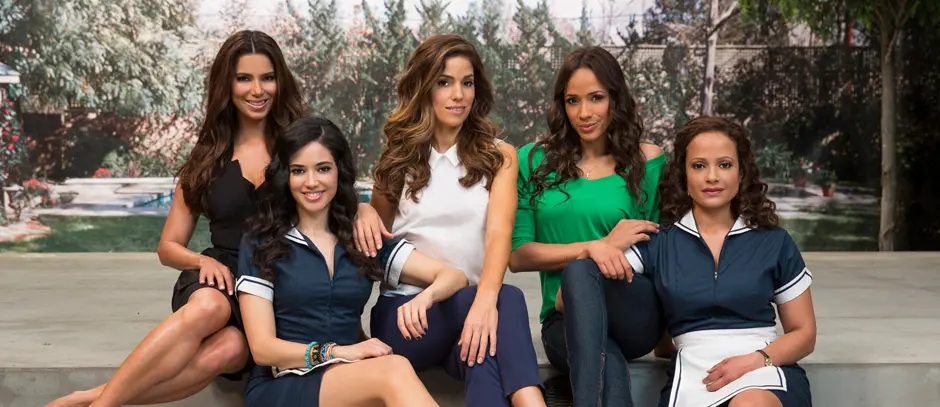
Devious Maids is worth a watch for at least the first two episodes, but it is definitely not must-see TV the way Desperate Housewives was in its first season. Created by Marc Cherry, the Lifetime drama attempts to blend mystery with social commentary through a specific cultural lens.
The Gist
We follow five Latina maids with ambition and dreams of their own while working for the rich and famous in Beverly Hills. The series balances their personal struggles with the overarching mystery of a murdered colleague, setting a tone that is part soap opera and part whodunit.
What Works
Seeing that many Latinas as the stars of an English language television show is definitely a sight to behold, whether they are maids or not. It is actually the first show to ever have five Latina leads in television. What is great to see is the evolution of the extraneous maid role: it has gone from invisible to front and center.
In addition, Latino stories on anglo television are hard to come by. I am glad to see Marc Cherry putting the weight of his creative strength into a bilingual narrative, albeit with a flair for the sensational and colorful. For those interested in the creator’s previous work, you can read our thoughts on other TV reviews from this era.
What Doesn’t Work
The acting as a whole is a problem. It is subpar compared to most dramas on television right now. Judy Reyes is by far the best actress of the cast with Edy Ganem’s striking allure a surprising treat, but muting their efforts is Cherry’s framing of the Devious Maids universe—a platitudinous, kitschy one with a twisted appeal.
You could say Cherry and producers are aiming for “train wreck television with empathy and heart.” You can ascertain the traces of tackiness through the musical score filled with clichéd Mexican guitar strings and tango violins. Many wonder if Eva Longoria’s Devious Maids is stereotyping Latinas, and the aesthetic choices certainly fuel that debate.
Watch It or Not?
My premonition is that Latino viewers will watch, but mostly to see how the “gringos” are portraying the Latino culture. They might ask, “Have they gotten us right? Are we presented in a cool light as to brag or boast to our non-Hispanic friends?”. Amongst them will obviously be the real Latina maids of America, which I personally don’t think will be fans of the show because it is a heightened, unrealistic depiction of what really goes on at their employers’ homes.
Then the Mexicans who saw the original novela, Televisa’s Ellas son la Alegría del Hogar, in Mexico, will be curious to see the remake. But if any of them feel even moderately offended in any way, they’ll leave and most likely never come back. The failure will be twofold—one for Lifetime having a flop and the other in setting back Hispanic-themed shows because the show wasn’t popular enough.
Stereotype Controversy
Much of the controversy behind it has circled around the stereotyping of Latinos. I’m not sure the accusations are precise. If I were to stereotype my own culture, I would never begin by classing them as maids. To be frank, the Hispanic culture is too diversely fragmented to put labels on them.
The issue I have is mostly personal. We as a community are grappling to elude subservient roles in media. By constantly being portrayed in that light on film and television, other less educated individuals will think we’re okay with it and we’re not. I don’t like to see Latinos in deferential roles, period, even if they are the principal protagonists.
For more TV reviews, check out our TV Reviews archive.